Showing posts with label Inflation. Show all posts

What's the Fed doing? One view

Torsten Slok of Deutsche Bank Research, showed me a slide deck he prepared for evaluating the US economy. Here are a few fascinating graphs. Sorry, the slide deck isn’t public – you have to pay DB for this kind of art!

Most hilariously, “forward guidance” seems to be getting harder.


Torsten also makes the case that interest rates are much below the Fed’s usual “Taylor rule.” Implicitly, it’s supply now not “demand.” The market of people who are working looks recovered, the large number of people out of the labor force is the problem, and addressing that is, at least, a deviation from usual policy.


The rest of Torsten’s slide deck makes a persuasive case that strong growth may finally be just around the corner, a warning to anyone spending a lot of time on “secular stagnation” models!

No editorial here, I just thought the graphs were really interesting. Thanks to Torsten for allowing me to post them.

Richmond Fed Interview

Richmond Fed Interview

The Richmond Fed published a long interview with me in their Econ Focus, shorter pdf (print) version here and longer web version here. Some of the questions:

  • Does the 2010 Dodd-Frank regulatory reform act meaningfully address runs on shadow banking?
  • So what do you think is the most promising way to meaningfully end “too big to fail”?
  • Do you think there’s any reason to believe recessions following financial crises should necessarily be longer and more severe, as Carmen Reinhart and Kenneth Rogoff have famously suggested?
  • Many people have asked whether the finance industry has gotten too big. How should we think about that?
  • What are your thoughts on quantitative easing (QE) — the Fed’s massive purchases of Treasuries and other assets to push down long-term interest rates — both on its effectiveness and on the fear that it’s going to lead to hyperinflation?
  • Both fiscal and monetary policies have been on extreme courses recently. What are your thoughts on how they might affect each other as they move back to normal levels?
  • Switching gears to finance specifically, what do you think are some of the big unanswered questions for research?
  • You wrote an op-ed on an “alternative maximum tax.” What’s the idea there?
  • Can transfers really help the bottom half of the income distribution?
  • Which economists have influenced you the most?
You’ll have to click to the interview for answers!

Thanks to Aaron Steelman, Lisa Kenney and especially  Renee Haltom, who helped a lot with the editing. I’m a lot less coherent in person!

Dupor and Li on the Missing Inflation in the New-Keynesian Stimulus

Bill Dupor and Rong Li have a very nice new paper on fiscal stimulus: “The 2009 Recovery Act and the Expected Inflation Channel of Government Spending” available here.

New-Keynesian models are really utterly different from Old-Keynesian stories. In the old-Keynesian account, more government spending raises income directly (Y=C+I+G); income Y then raises consumption, so you get a second round of income increases.

New-Keynesian models act entirely through the real interest rate.  Higher government spending means more inflation. More inflation reduces real interest rates when the nominal rate is stuck at zero, or when the Fed chooses not to respond with higher nominal rates. A higher real interest rate depresses consumption and output today relative to the future, when they are expected to return to trend. Making the economy deliberately more inefficient also raises inflation, lowers the real rate and stimulates output today. (Bill and Rong’s introduction gives a better explanation, recommended.)

So, the key proposition of new-Keynesian multipliers is that they work by increasing expected inflation. Bill and Rong look at that mechanism: did the ARRA stimulus in 2009 increase inflation or expected inflation?  Their answer: No.


This is a quantitative question. How much do the large-multiplier models say the ARRA should have increased inflation? Their answer: 4.6%. Where is it?

We know, of course, that inflation (especially core inflation) basically did nothing during the period of the ARRA, and Bill and Rong have some nice graphs. Defenders might say, aha, but except for the stimulus, we would have had a catastrophic deflation spiral. Critics might reply, that’s what George Washington’s doctors said while they were bleeding him. As always, teasing out cause and effect is hard.

Bill and Rong have a range of interesting facts that address this question. Here are two that I thought particularly clever. First, they look at the survey of professional forecasters, and examined how the forecasters changed inflation forecasts along with their changes in government spending forecasts, i.e. when they figured out a big stimulus is coming. I plotted the data from Bill and Rong’s Table 2

Dupor and Li Table 2
As you can see, in 2008Q4 and 2009Q1, many forecasters updated their views on government spending, a few by a lot.  However, there is next to no correlation between learning of a big stimulus and increases in expected inflation, especially among the forecasters who strongly update their stimulus forecasts.

Bill and Rong’s interpretation is that the stimulus failed to increase expected inflation. The main defense I can think of is to say that this evidence tells us about professional forecaster’s model, not about true inflation expectations. Professional forecasters are a bunch of old-Keynesians, not properly enlightened new-Keynesians; they don’t realize that stimulus works through inflation, they’re still thinking about a pre-Friedman consumption function. That’s probably true. But if so, it’s hard to think that everyone else in the economy does understand the new truth, and changed their inflation forecasts dramatically when they learned of the stimulus.

Another nice piece of evidence: The US had much bigger government spending stimulus than the UK. The behavior of expected inflation revealed in the real vs. nominal treasury spread was almost exactly the same. (Yes, Bill and Rong delve into the TIPS pricing in the crisis.)

Source: Dupor and Li

Finally, a key point missing in most of the stimulus debate. These models predict big multipliers not just at the zero bound, but anytime that interest rates don’t respond to inflation. We don’t have to just rely on theory, there is some experience. New-Keynesians since at least Clarida Gali and Gertler’s famous regressions have said that the Fed was not increasing interest rates fast enough in the 1970s, and the 1930s and interest-rate peg of the late 40s and early 50s are another testing ground. Using standard measures of exogenous spending increases, Bill and Rong find no impact of government spending on inflation in any of these periods.

New Keynesian stimulus analysis has been particularly slippery, on the difference between the models and the words, and on advocating the policy answers without checking or believing the mechanisms. The models are Ricardian: the same stimulus happens whether paid for by taxes or borrowing. The opeds scream that the government must borrow. The models say totally useless spending stimulates. The opeds are full of infrastructure, and roads and bridges. (At least, the “sprawl”  complaint is temporarily quiet.) The models say that spending works by creating inflation, not through a consumption function. Inflation being totally flat, and the counterfactual argument weak, you don’t hear much about that in the opeds.  The models say we should be in a huge deflation with strong expected output growth. The facts are protracted stagnation. (More in my last stimulus post.) The models are models, worthy of careful examination and empirical testing. All I ask is that their proponents take them seriously, and not as holy water for a completely different old-Keynesian agenda.

Rogoff on UK Defaults

Rogoff on UK Defaults

Ken Rogoff wrote a very interesting FT oped on UK finances (FT original, Rogoff webpage if you can’t see FT.)

The issue: Should we worry about huge sovereign debts of advanced countries? Or was the only problem with fiscal stimulus that it was not big enough?


A little history:
Yes, from the 1800s until the first world war, the UK was a global superpower that commanded vast colonial resources and investments. Over long periods, these foreign assets yielded returns well in excess of interest on debt. But comparing government debt ratios back then, when the UK was a massive net creditor, to debt ratios today, when British foreign liabilities exceed foreign assets, is utterly misleading. Moreover, back in the 1820s, the UK was pioneering the industrial revolution; things are not quite the same today. Back then, the UK did not have to worry about pension liabilities or existential threats to the banking system that could require massive injections of cash to fix. …

During the 1930s, Britain defaulted on debt to the US accumulated during the first world war and its aftermath. …

It is often stated that after the second world war the UK debt reached almost 250 per cent of gross domestic product and was brought down merely through growth and inflation. This is a myth …

Then there is the high-inflation era of the 1970s – another de facto default. Last but not least, what about the UK’s serial dependence on International Monetary Fund bailouts from the mid-1950s until the mid-1970s? This is hardly a country with an indestructible credit status. …

Being a UK bondholder has had its ups and downs.

Looking forward, an important point: a country needs to be substantially below its ultimate borrowing limit, or it loses its ability to fight crises going ahead.
..a euro collapse would have triggered a stampede out once investors realised that the UK banks and trade would be savaged, a flexible currency notwithstanding. In that scenario, UK leaders would have been forced to close massive budget deficits almost overnight. That would have been truly catastrophic austerity. …

We now know the euro did not collapse. [yet – JC] With 20-20 hindsight, yes, the UK could have borrowed more. But we do not have hindsight at the moment decisions have to be taken. 
Kan and Carmen Reinhart have been at the receiving end of Paul Krugman’s tender commentaries lately, and I’m interested to see Ken taking up the issue. Krugman likes to lambaste people for “predictions” that he imagines they made which didn’t come out. On the euro blowing up, Ken seems to be offering a taste of his own medicine, made more bitter by the fact that Krugman actually did say what Ken says he said:
…This was the big call – the one that everyone was focusing on. To state that credit risk was gone by 2010 is ludicrous. None other than The New York Times columnist Paul Krugman prognosticated the euro’s early demise regularly from April 2010 to July 2012. His big call has turned out – so far – to be dead wrong.
I will be curious if we see more of that from Ken. Stay tuned.

Miron and Rigol go after a classic

Jeff Miron and Natalia Rigol have a provocative working paper, “Bank Failures and Output During the Great Depression.” They take on one of Ben Bernanke’s most famous papers.

Bernanke concluded that the great depression was severe not because of a lack of money– medium of exchange – but because of the credit effects of so many bank failures.

You may say, “duh,” but it’s not so easy. If bank A fails, what stops you from going and getting a loan from bank B? Well, if your ability to get a loan is wrapped up in the knowledge that employees of bank A have about you. And if, as a result of some sort of friction, Bank B doesn’t hire those people for their knowledge. And if, as a result of another friction, someone can’t come buy the assets of Bank A, including people and knowledge, and continue to operate the bank. In the great depression, restrictions on branches and interstate banking did that. The process is, fortunately, much swifter now that the assets of a small local bank can be swiftly bought up by other banks even out of state.

Bernanke’s paper was - and is – enormously influential. It was part of a movement to put credit rather than money at the heart of monetary economics and understanding of Fed policy.

But, as Jeff and Natalia point out, what if the banks fell because output was going down, not the other way around? How strong was Bernanke’s actual evidence?

Source: Jeff Miron and Natalia Rigol

The graph, from the paper, makes the basic point. We can argue about the “bank holiday” but you see that even the other failures came rather late in the game. It’s not at all obvious that bank failures cause output declines and not the other way around.

And of course, “the economy will tank if banks go under” is the mantra that produced the bailouts. Jeff and Natalia’s closing words:
To the extent U.S. experience during the Great Depression – and especially the view that bank  failures played a significant, independent role during that period – formed the intellectual foundation for  Treasury and Fed actions, however, our results suggest a hint of caution. If the Great Depression does not constitute evidence for Too-Big-to-Fail, then what historical episodes do provide that evidence? We leave  that question for another day
There are lots of important unsettled issues, justifying Jeff and Natlia’s cautious tone in the paper.  How about regional evidence – didn’t  towns whose banks failed suffer more than others, and had lower loan volumes? (I vaguely remember seeing that.  I don’t pretend to be an expert on empirical great depression work. If someone has the cross-sectional evidence, add a comment.)

Still, given how the “credit channel” view underlies most of Fed thinking, even though inequalities by definition don’t always bind, and how deeply the “we can’t let banks fail or there won’t be any new lending” view underlies so much crisis policy, I salute a careful reexamination of even classic “facts.”

Update:

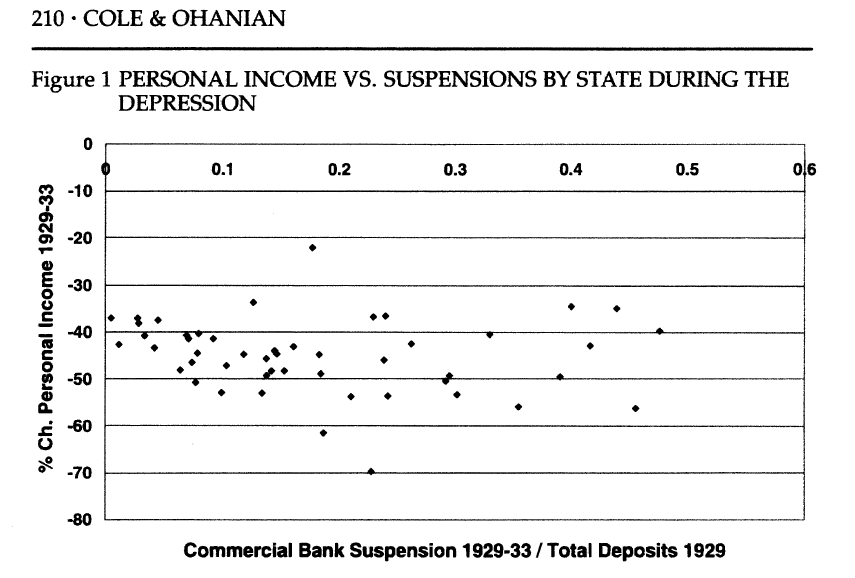
On the cross-sectional point, Hanno Lustig found Hal Cole and Lee Ohanian’s “Reexamining the contributions of money and banking shocks to the U.S. great depression” and suggests this graph as a summary. Not even in the cross section. Thanks Hanno!

Source Hal Cole and Lee Ohanian

The New-Keynesian Liquidity Trap

I just finished a draft of an academic article, “The New-Keynesian Liquidity Trap"  that might be of interest to blog readers, especially those of you who follow the stimulus wars. 

New-Keynesian models produce some stunning predictions of what happens in a "liquidity trap” when interest rates are stuck at zero.  They predict a deep recession. They predict that promises work: “forward guidance,” and commitments to keep interest rates low for long periods, with no current action, stimulate the current level of consumption.  Fully-expected future inflation is a good thing. Growth is bad. Deliberate destruction of output, capital, and productivity raise GDP. Throw away the bulldozers, let them use shovels. Or, better, spoons. Hurricanes are good. Government spending, even if financed by current taxation, and even if completely wasted, of the digging ditches and filling them up type, can have huge output multipliers.

Even more puzzling, new-Keynesian models predict that all of this gets worse as prices become more flexible.  Thus, although price stickiness is the central friction keeping the economy from achieving its optimal output, policies that reduce price stickiness would make matters worse.

In short, every law of economics seems to change sign at the zero bound. If gravity itself changed sign and we all started floating away, it would be no less surprising.

And of course, if you read the New York Times, people like me who have any doubts about all this are morons, evil, corrupt, and paid off by some vast right-wing conspiracy to transfer wealth from the poor to the secret conspiracy of hedge fund billionaires.

So I spent some time looking at all this.

It’s true, the models do make these predictions. However, there is a crucial step along the way, where they choose one particular equilibrium. There is another equilibirum choice, where all of normal economics works again: no huge recession, no huge deflation, and policies work just as they ought to.

I took a setup from Ivan Werning’s really nice 2012 paper: There is a negative “natural rate” from time 0 to time T, and the interest rate is stuck at zero. After that, the natural rate becomes positive again, and everyone expects the actual interest rate to follow. I solved the standard new-Keynesian model in this circumstance – forward-looking “IS” and Phillips curves.


This is Werning’s “standard” equilibrium choice, which shows all the new-Keynesian predictions. The liquidity trap lasts until T=5, shown as the vertical line in the middle of the graph.

The thick red line is inflation. As you see, there is huge deflation during the liquidity trap, though deflation is steadily decreasing.

The dashed blue line is output (deviation from  "potential".) As you see, there is a huge output gap, though strong expected output growth as it comes back to “trend” at the end of the trap. This is why growth is bad – in these models you always come back to trend, so if you can lower growth, that raises today’s level.

The thin red dashed lines marching toward the vertical axis show what happens as you reduce price stickiness. (I only showed inflation, output does the same thing.) As you reduce price stickiness, it all gets worse – output at any given date falls dramatically. For price stickiness epsilon away from a frictionless market, output falls to zero and inflation to negative infinity.

I verify in the paper that all the claimed policy magic works in this equilibrium.  Even a small amount of “forward guidance” can dramatically raise output, wasted-spending multipliers can be as large as you like, and those policies get more effective as price stickiness gets smaller.

However, for the same interest rate path, there are lots and lots of equilibria.


This graph shows a different equilibrium. I call it the “local-to-frictionless” equilibrium. Again, the thick  red line is inflation. Now, during the liquidity trap, there is steady, mild inflation. The inflation pretty much matches the negative natural rate, so the zero interest rate during the trap (from t=0 to t=T=5) produces a the real interest rate near the natural rate.

As the trap ends, inflation slowly declines and then takes a “glide path” to zero – i.e. zero deviation from trend, or back to the Fed’s long-run target.

In this equilibrium, there is a small increase in potential output, shown in the dashed blue output line. The new-Keynesian Phillips curve says that when inflation today is higher than inflation tomorrow, output is above potential.

As we turn down price stickiness, the thin red lines show that inflation smoothly approaches the totally frictionless case, positive inflation from 0 to T and zero inflation immediately thereafter. I didn’t have room to show it, but  output smoothly approaches a flat line as well.

The paper shows that all the magical policies are absent in this equilibrium: The multiplier is always negative, announcements about the far off future do no good, and deliberately making prices sticker doesn’t help.

These are not different models. These are not different policies or different expected policies. Interest rates follow exactly the same path in each case, zero from t until T=5, and following the natural rate thereafter. These are different equilibrium choices of the same model. Each choice is completely valid by the rules of new-Keynesian models. I don’t here challenge any of the assumptions, any of the model ingredients, any of the rules of the game for computation. Which outcome you choose is completely arbitrary.

The difference between the calamitous equilibrium and the mild local-to-frictionless equilibirum, in this model, is just expectational mulitple equilibria (with an implicit Ricardian regime.) If people expect the inflation glide path, we get the benign equilibrium. If they expect inflation to be zero the minute the trap ends, we get the disaster.

The paper goes on to compute all the magical policies, consider Taylor rules, and every other objection I can think of. So far.

What do I make of all this? Well obviously, maybe one isn’t so dumb, evil, or corrupt for having doubts about changing the sign of all economic principles when interest rates hit zero.

Let me just quote from the conclusion
At a minimum, this analysis shows that equilibrium selection, rather than just interest rate policy, is vitally important for understanding these models’ predictions for a liquidity trap and the effectiveness of stimulative policies. In usual interpretations of new-Keynesian model results, authors feel that interest rate policy is central, and equilibrium-selection policy by the Fed, or equilibrium-selection criteria, are details relegated to technical footnotes (as in Werning 2012), game-theoretic foundations, or philosophical debates, which can all safely be ignored in applied research. These results deny that interpretation.

….there really are multiple equilibria and choosing one vs. another is simply an arbitrary choice. Since there is an equilibrium with no depression and deflation, and no magical policy predictions, one cannot say that the new-Keynesian model makes a definite prediction of depression and policy impact.

I have not advocated a specific alternative equilibrium selection criterion. Obviously, the local-to-frictionless equilibrium has some points to commend it: It is bounded in both directions, it produces normal policy predictions, it has a smooth limit as price stickiness is reduced, and it does not presume an enormous fiscal support for deflation. But this is not yet economic proof that it is the “right” equilibrium choice.

We might consider which equilibrium choice is more consistent with the data. The US economy 2009-2013 features steady but slow growth, a level of output stuck about 6-7% below the previous trendline and the CBO’s assessment of “potential,” a stagnant employment-population ratio, and steady positive 2-2.5% inflation.

The local-to-frictionless equilibrium as shown in my second Figure can produce this stagnant outcome, but only if one thinks that current output is about equal to potential, i.e. that the problem is “supply” rather than “demand,” and that the CBO and other calculations of “potential” or non-inflationary output and employment are optimistic, as they were in the 1970s, and do not reflect new structural impediments to output.

The standard equilibrium choice as shown in my first Figure cannot produce stagnation. It counterfactually predicts deflation, and it counterfactually predicts strong growth. One would have imagine a steady stream of unexpected negative shocks – that each year, the expected duration of the negative natural rate increases unexpectedly by one more year – to rescue the model. But five tails in a row is pretty unlikely.

The problem in generating stagnation is central to the new-Keynesian model. The “IS” curve and the assumption that we return to trend means that we can only have a low level of output and consumption if we expect strong growth. The Phillips curve says that to have a large output gap, we must have inflation today much below expected inflation tomorrow and thus growing inflation (or declining deflation). Thus if we are to return to a low-inflation steady state, we must experience sharp deflation today.  If one wants a model with stagnation resulting from perpetual lack of “demand,” this model isn’t it. Static old-Keynesian models produce slumps, but dynamic intertemporal new-Keynesian models do not.
….
I close with a few kinds words for the new-Keynesian model. This paper is really an argument to save the core of the new-Keynesian model – proper, forward-looking intertemporal behavior in its IS and price-setting equations – rather than to attack it. Inaccurate predictions for data (deflation, depression, strong growth), crazy-sounding policy predictions, a paradoxical limit as price stickiness declines, and explosive off-equilibrium expectations, are not essential results of the model’s core ingredients.  A model with the core ingredients can give a very conventional view of the world, if one only picks the local-to-frictionless equilibrium. That model will build neatly on a stochastic growth model, represented here in part by the forward-looking “IS” equation and changes in “potential.” Its price stickiness will modify dynamics in small but sensible ways and allow a description of the effects of monetary policy. This was the initial vision for new-Keynesian models, and it remains true.

Really, the fault is not in the core of the new-Keynesian model. The fault is in its application, which failed to take seriously the fundamental problem of nominal indeterminacy…. Interest rate targets, even those that vary with output and inflation, or money supply control with interest-elastic demand, simply do not determine the price level or inflation.  In a model with price stickiness, nominal indeterminacy spills over in to real indeterminacy.

In that context, this paper shows there is an equilibrium choice that leads to sensible results. Alas, those sensible results are non-intoxicating. In that equilibrium, our present (2013) economic troubles cannot be chalked up to one big simple story, a “negative natural rate” (whatever that means) facing a lower bound on short term nominal rates; and our economic troubles cannot be solved by promises, or a sign reversal of all the dismal parts of our dismal science. Technical regress, wasted government spending, and deliberate capital destruction do not work. Growth is good, not bad. That outcome is bad news for those who found magical policies an intoxicating possibility, but good news for a realistic and sober macroeconomics.
    
If all this just whets your appetite, I hope you will read the paper. Similarly, if you’re brimming with objections, take a look at my attempts to anticipate most objections – what about the Taylor rule, etc. – in the paper.

(This follows an earlier paper in the JPE (online appendix) looking deeply at multiple equilibria in new-Keynesian models. In that paper, I questioned whether ruling out multiple explosive equilibria made sense. In this paper, I accept that part of the rules of the game, and think about the mulitple non-explosive equilibria.)

Fed Chair

Fed Chair

My pick for Fed chair below. I don’t have much to say on the choice between Janet Yellen and Larry Summers. Both are worthy economists, with well-discussed pluses and minuses on which I have no particular insight.

So, this post is about who else one might want to look at, and much more importantly the broader question about what makes a good Fed chair.


The press mostly  wants a soothsayer, who will foresee events the market does not see and calm the waters – in practice,  basically operating the worlds largest contrarian hedge fund, or the commissariat of macroeconomic central planning. Such people don’t exist, so that’s a self-defeating job description. Let’s talk about reality.

The Fed chair will not just have to pick the right course, but will also have to wade through the cacophony of advice and pressure he or she will receive, from politicians, powerful banks and businesses, outside critics – people like me – and the crosswinds of contradictory advice from Fed board members, staff and regions. And then guide a headstrong committee and a ponderous bureaucracy to those ends.

To do that, a chair needs a clear intellectual framework and a core set of principles.

He or she must deeply understand modern macroeconomics, finance, and banking. Too many policy-oriented people are mired in simpleminded 1970-era Keynesian story-telling that they learned as undergraduates, and a similarly simplistic understanding of finance. Too many academic economists are too deep into modern work, take equations at face value and do not know how to distill and apply their essential lessons, and what lessons are robust from the inevitable simplifcations of all formal models. Too many bankers have little understanding at all of cause and effect. Long practical experience in a system produces little experience of how to guide that system.

The FOMC (Federal Open Market Committee) of bank presidents and governors is now as high-powered a group as you could imagine. The academics have taken over. They know their stuff, and so does their staff. When the staff brings in or a governor cites “unique locally bounded equilibria” of the latest “new-Keynesian DSGE model,” or distills the tea leaves of interest rates in “three factor affine models,” a chair must find the nuggets of gold, the grains of salt, and the remains of horses. All three are present.

There is a tendency in many quarters, reflected well in the New York Times opinion pages, to dismiss modern macro as hogwash. (Except, of course, when particular equilibria of particular new-Keynesian models produce pleasing multipliers.) Dismissing all modern thinking is as dangerous as accepting it all uncritically. If for no other reason, this is the language the FOMC and its staff speak, so a chair who doesn’t understand it will simply be bamboozled.

We are at a crossroads in monetary policy,  with deeply different intellectual frameworks bounding the discussion, from monetarists, old-fashioned IS-LM Keynesians, Minnesota/Chicago dynamic equilibrium, new-Keynesian DSGE all talking past each other in essentially different languages. And I haven’t started on financial views, even more disparate. The chair must be literate! And this stuff is hard. Well, I think it’s hard. It’s going to be hard to find someone who has not been actively contributing to this thinking who really understands what’s going on.

An ideal chair has the universal admiration and respect of all in the room – they may disagree, but everyone knows the chair deeply understands all the modeling points of view. An ideal chair also has the rare talent to explain and apply modern macroeconomics, not just push the equations around correctly.

More deeply, the fundamentals of modern macro – thinking intertemporally, thinking about expectations, rules, institutions, moral hazards, precommitment vs. discretion, not in static terms of this year’s stimulus and this year’s GDP, really are important guides to a successful central bank.

That intellectual framework should be broad as well as deep. Some people have one great idea and to Washington to  implement their pet idea. Such people do not often do well when asked to guide a large institution through, inevitably, uncharted waters. Great military theorists do not make great battlefield generals.

A great Fed chair also understands history, and the legal and institutional structure of the Federal Reserve and previous central banks. Too many academics, (I include myself, though I’m trying to repair the damage)  are steeped in theory and quantitative evidence, but pretty light on the simple facts of what happened in past crises.

Nobody can know everything, however, so the Fed chair needs a few core principles. Paul Volcker had them, when the cacophony of experts said we couldn’t stop inflation. Ronald Reagan had them, when he said “tear down this wall” over the cacophony of experts. And those principles need to be right.

So, a great Fed chair is not so much smart as wise. There is a big difference. Humility is a bedrock of wisdom. The chair needs clearly to understand the limits of our knowledge, how imperfectly we understand cause and effect of the Fed’s policy tools.  A wise chair remembers how much consensus views on those matters have changed in the past, and knows how much they will change in the future.  If the Chair does a good job, ideas will change in response to the slow accumulation of experience and not in the wake of some new disaster borne of overconfidence in wrong ideas.

Above all, a successful chair will avoid screwing up! The Fed is a defensive institution. Like oil in the car, you don’t notice it when it’s doing its job well, and it mainly is in the news when it fails. It is not an institution that succeeds by leading great charges to direct the economy.

The big past screwups came when old ideas met new events, as they did in the banking crises of the great depression and the unleashing of the great inflation of the 1970s, just as on the 1914 western front and Maginot line.

An ideal chair has thought a lot about issues which are likely to be the next great crisis. Ben Bernanke was one of the great scholars of the bank runs of the Great Depression, and in part as a result the Fed did not repeat many of the mistakes of that event.

But we never fight the last war, at least right away. The chance of us having another real estate boom, a huge increase in shadow banking, a run in short term debt linked to mortgages in the next 10 years is next to zero.  So what are the challenges going forward, and what special expertise would one want in a Fed chair?

It seems obvious to me that sovereign debt, sovereign promises, an emerging period of sclerotic growth (rather than “lack of demand” recession) and how monetary policy is fundamentally affected by this set of circumstances is going to be a big issue for the Fed going forward. A chair who relies only on rules of thumb or correlations that held in a time of high trend growth and small sovereign debts is going to be taken by surprise.

An ideal Fed chair has spent a lot of time thinking about, and surveying the wide historical and cross-country experience on, the link between monetary policy, sovereign finances, and large-scale economic fluctuations. When California and Illinois default, Spain can’t roll its debts, Germany refuses to recapitalize the ECB, and US long rates spike, a chair armed only with shifting around IS and LM curves and bailing out creditors will fall flat.

It also seems obvious to me that financial regulation, the temptations to financial micromanagement, and the forces of capture by the financial industry, are going to fill the Fed’s plate as much or more than the mundane question of whether to raise or lower short term interest rates by a few basis points.

Financial regulation is even more about moral hazard, rules, institutions and perceptions than regular monetary policy. Chair William McChesney Martin, referring to rising interest rates, once sad the job of the Federal Reserve was to take away the punch bowl just as the party gets going. Now that the Fed is managing “financial stability,”  the chair’s job is to more to stop putting out fires soon enough that the underbrush burns out, people don’t build their houses too close to trees, and keep their own fire extinguishers loaded. At some point, you  let Bear Stearns go to send a message to Lehman Brothers.  A Fed chair that spends a lot of his time clarifying what the Fed’s role will be in the next crisis rather than one who just ammasses larger and larger discretionary power, will weather that crisis much better.

Resisting capture will be a full time job. When billions of dollars are on the line for powerful Wall Street firms, the chair needs to be someone who can say no – and who everyone knows will say no. From before the Fed’s inception, people have wanted to manipulate monetary policy and financial regulation to their ends.  They will steer subsidies and protection their way, they will use regulation to block competition, and they will steer credit their way.

We didn’t have a central bank for a century, mostly because of this fear. The argument over having a central bank at all focused on the concentration of financial power and its marriage to political power, not inflation and unemployment. Now that the Fed is squarely running the financial system, and not just setting interest rates, we will start that discussion again.

Ideally it would not matter at all who the Fed chair is. Our government works well when the institutions work, not when we await the right benevolent aristocrat to run things with great power and no accountability. So a wise central banker is not one in the news every day, spouting a frenzy of new ideas. The wise central banker works within and buttresses well codified rules of behavior, thinks hard about what those rules should be, and slowly moves them over time.

Oh, and politics matter. Pick a Democrat.

So who fills that bill? I’ve pretty much described Tom Sargent. If you want a taste, go to his website. His latest paper “Fiscal discrimination in three wars” with George Hall is just what I would want a Fed Chair to be thinking about with state and local defaults looming. His Nobel Prize speech “US Then, Europe now” is one of the wisest set of thoughts on the Euro crisis I’ve seen. Some of my favorite classics: “The macroeconomics of the French Revolution” with Francois Velde. There you see how Tom can put modern macro into action, to understand real-world events. Of course his studies of the fiscal roots of hyperinflations are fundamental. He knows macroeconomic theory of all stripes inside and out. He knows the history and institutions inside and out.  He is one guy who could command hushed awe in the FOMC.

There are a few other candidates who fit the bill similarly. I don’t want to get too deep in to personalities, it’s the job posting that counts. You could make a similar case for, among others Ken Rogoff, David Romer, John Taylor, Mike Woodford, Greg Mankiw, and many others. (Just examples; I don’t mean to insult anyone by omission). The interesting observation is that none of these are on the agenda reported in the papers.

There is perhaps two good reasons why such candidates are not on the table. First,  the Fed chair runs a large organization. The talents of corralling a bureaucracy, herding the opinionated cats on the board of governors, keeping the staff in line, working within the legal and institutional structure of the Fed, keeping one’s mouth shut so as not to roil markets and cause scandals, (or perhaps talking so much that markets stop paying attention? That’s what would happen if I were Fed chair!) while furthering the Fed’s admirable quest of transparency are crucial.

Second, the chair has to make hard decisions in real time. This is incredibly hard.

Most academics don’t have these skills. I don’t know if Tom does. Perhaps some trial of running a large organization is a needed requirement.

And of course, the chair needs to persuade one person he or she will be good at the job, the president. Ben Bernanke served on George Bush’s council of economic advisers, and undoubtedly impressed Bush. Tom impresses me, but I’m not in charge.

You may object that I’m thinking too narrowly. I’m a university academic, so I’m pushing other university academics. But in this case, I think that’s warranted. The academics really have thought long and hard about central banking, and they have taken over from the bankers. The FOMC is a great debating club of monetary and financial policy. An industry economist or banker will get eaten alive.

By the way, I think when the dust has settled, history will be kind to Ben Bernanke. He fits most of my job description. Inflation is stuck at 2%, the world did not melt down, and we’re all gradually coming to the realization that if $2 trillion bucks of stimulus and zero interest rates didn’t bring our economy out of the doldrums, there really is nothing more that a central bank could do. The Phillips curve has been screaming “this is supply, not demand” for a few years now. Like any great general, we can argue with specific decisions, and much of the direction of Fed policy, and I have. But we have not lost the war.

Yet. The next chair could easily make Mr. Bernanke’s term look even better.

The Fed and Shadow Banking

The Fed and Shadow Banking

The WSJ has a fascinating Op-Ed by Andy Kessler, “The Fed Squeezes the Shadow-Banking System” Andy thinks that Quantiative Easing has the opposite, contractionary effect.

QE is just a huge open market operation. The Fed buys Treasury securities and issues bank reserves instead. Why does this do anything? Why isn’t this like trading some red M&Ms for some green M&Ms and expecting it to affect your weight?  (M&M of course stands for “Modigliani Miller” if you didn’t get the joke.)

The usual thinking is that bank reserves are “special.” They are connected to GDP in a way that Treasuries are not.  In the conventional monetary view, MV = PY.  Bank reserves, through a multiplier, control M. The bank or credit channel view says that bank reserves control lending and lending affects PY. The red M&Ms, though superficially identical, have more calories.

In Andy’s view (my interpretation), that is turned around now. Now, Treasuries supply more “liquidity” needs than bank reserves, and (more importantly) the supply of treasuries is more connected to nominal GDP than is the supply of bank reserves.

Part of this inversion of roles is supply. In place of the usual $50 billion, we have $3 trillion or so bank reserves. Bank reserves can only be used by banks, so they don’t do much good for the rest of us. Now, they just sit as bank assets in place of mortgages or treasuries and don’t make a difference to anything. More treasuries, according to Andy, we can do something with.

More deeply, constraints only go one way. Normally, the banking system is up against a constraint. Reserves pay less interest than other assets, so banks use as little as possible. Now, they are awash in liquidity. You can’t push on a string, as the saying goes. Much “constraint” economics forgets that once the constraint is off, the relationship doesn’t hold any more.

Andy describes the repo market and the sense in which Treasuries are “special” in providing low-haircut collateral. Lots of academic research is now viewing Treasuries as special or liquidity-providing in the shadow banking system.

So, this is at least a gorgeous possibility: In a frictionless world, open-market operations, buying one kind of government debt (Treasuries) and issuing another (reserves)  have zero effect on anything, by the M&M theorem. Monetary economics thinks the M&M theorem is violated, because one kind of government debt (M) is connected to nominal GDP and the other is not.

But financial systems change. When the textbooks were written, banks mattered a lot, so bank reserves, leveraged to loans and checking accounts, were the “special” asset. In today’s market, and given today’s glut of reserves, Treasuries, leveraged to mortgage backed securities and money market funds through the repo market and “shadow banking system,”  might be the “special” asset connected to nominal GDP. In that case, the effects of open market operations might have the opposite sign. As Andy says,

… the Federal Reserve’s policy—to stimulate lending and the economy by buying Treasurys..—is creating a shortage of safe collateral, the very thing needed to create credit in the shadow banking system for the private economy. The quantitative easing policy appears self-defeating, perversely keeping economic growth slower and jobs scarcer.
I’m not totally convinced, though this story and the alleged enormous demand for Treasuries is being bandied around as established fact. I’m also not convinced that this is all a good idea. Maybe the Fed should starve the shadow banking system.

You repo a security so that you can borrow against it. For example, you might buy a mortgage-backed security, then leave (repo, really) that security as collateral for a loan, which you used to buy the security in the first place. But what sense does it make to repo-finance a Treasury? You can’t borrow at lower interest rate to make money on a Treasury! You could, possibly, if it’s a long term Treasury and you’re borrowing short, betting that interest rates don’t rise. But I would think an interest rate swap or future would be a cheaper way to make that bet, and anyway betting on the slope of Treasury yield curve doesn’t add up to the necessary GDP-linked lending that Andy has in mind.

In short, if you have money to buy a Treasury, why do you need to borrow? For any of this to get off the ground, you have to have some other, not totally rational,  reason for buying the Treasury, and then you want to borrow against the Treasury  so you can buy the risky asset that you really wanted all along. Who is that? Why is this such a necessary part of our financial system? Can’t we fix things so they just buy the MBS with their initial cash?

Andy points out that repos are re-hypothecated. You use your Treasury as collateral against a loan, then the guy you gave it to uses it again as collateral to get the money to give to you. So one Treasury is used as collateral against two or three loans. Hmm. As the money multiplier creates run-prone structures, so using the same thing as collateral two or three times is a lot of what makes banks “too big to fail.” If we all go down, who has the collateral?

A system awash in all kinds of liquidity, following the Freidman optimal quantity of money, seems a lot safer to me. I’d rather we expand the “bank reserve” concept – fixed-value, floating-rate, electronically-transferable Treasury debt, and lots of it, washing the shadow banking system in liquidity and putting the run-prone structures out of business. Of course, open market operations would then have no effect in my world either, as I have removed the liquidity constraint in the shadow banking system just as Mr. Bernanke has removed it in the conventional banking system. But violations of M&M always mean the system can be made better.

If you want to comment and explain shadow banking, please use little words that the rest of us can understand.
The Role of Monetary Policy, Revisited

The Role of Monetary Policy, Revisited

I am giving a talk Thursday May 30, titled  “The Role of Monetary Policy, Revisited."  The event is at Booth’s Gleacher Center in downtown Chicago, reception 4:30 and talk 5:15. It’s part of a series of talks sponsored by the Becker-Friedman Institute.

The talk is based on  an essay I’m working on, and will be presenting at a few central banks this summer. Once per generation we re-think what central banks do, can’t do, should do, and shouldn’t do. Milton Friedman’s famous 1968 address marked the last big transition. I think, we are in a similar moment. I will look at the big picture in the same spirit. I’m aiming at a serious talk, grounded in academic research, but accessible.

Blog followers, students, colleagues, friends, and even glider pilots are most welcome. Please rsvp so they know how many people to plan for.

The event announcement invitation and rsvp links are here on the BFI webpage

There is also an event announcement and rsvp link on the Booth Alumni events webpage here.


Problems viewing this e-mail? View it in a browser.
Becker Friedman Institute
The Becker Friedman Institute for Research in Economics of the University of Chicago cordially invites you to
The Role of Monetary Policy Revisited
A talk by John H. Cochrane, AQR Capital Management Distinguished Service Professor of Finance at the University of Chicago Booth School of Business
Thursday, May 30, 2013
4:30 p.m. Reception
5:15 p.m. Talk and Q&A
Executive Dining Room, Sixth Floor
University of Chicago Gleacher Center
450 North Cityfront Plaza Drive
Chicago, Illinois (map and directions)
Please join us as University of Chicago Booth School of Business Professor John Cochrane reexamines Milton Friedman’s 1968 presidential address to the American Economic Association. In this famous speech on the role of monetary policy, Friedman argued, "There is always a temporary trade-off between inflation and unemployment; there is no permanent trade-off.”
Starting from this perspective, Cochrane will reevaluate the role of monetary policy 45 years later. Is it effective? Can it fill all the roles people expect of it? How should monetary policy be conducted going forward?
RSVP
Please respond online by
May 23.
Please extend this invitation to others who might find the program of particular interest.
Complimentary valet parking will be available at the Gleacher Center entrance.
QUESTIONS
If you have questions or require advance assistance, please contact Maria Bardo-Colon at 773.834.1898 or bfi@uchicago.edu.
John H. Cochrane
The AQR Capital Management distinguished service professor of finance at the University of Chicago Booth School of Business, Cochrane’s scholarly work focuses on finance, monetary economics, macroeconomics, health insurance, time-series econometrics, and other topics. He is the author of
Asset Pricing, a coauthor of The Squam Lake Report, a research associate of the National Bureau of Economic Research, a senior fellow of the Hoover Institution at Stanford University, and an adjunct scholar of the CATO Institute. He blogs as The Grumpy Economist. Cochrane earned a bachelor’s degree in physics at Massachusetts Institute of Technology and PhD in economics at the University of California, Berkeley. He was a member of the University of Chicago Department of Economics before joining Chicago Booth.

More Interest-Rate Graphs

For a talk I gave a week or so ago, I made some more interest-rate graphs. This extends the last post on the subject. It also might be useful if you’re teaching forward rates and expectations hypothesis. 

The question: Are interest rates going up or down, especially long term rates?  Investors obviously care, they want to know whether they should put money in long term bonds vs. short term bonds.  As one who worries about debt and inflation, I’m also sensitive to the criticism that market rates are very low, forecasting apparently low rates for a long time. Yes, markets never see bad times coming, and markets 3 years ago got it way wrong thinking rates would be much higher than they are today (see last post) but still, markets don’t seem to worry.

But rather than talk, let’s look at the numbers. I start with the forward curve. The forward rate is the “market expectation” of interest rates, in that it is the rate you can contract today to borrow in the future. If you know better than the forward rate, you can make a lot of money.


Here, I unite the recent history of interest rates together with forecasts made from today’s forward curve. The one year rate (red) is just today’s forward curve. I find the longer rates as the average of the forward curves on those dates. Today’s forward curve is the market forceast of the future forward curve too, so to find the forecast 5 year bond yield in 2020, I take the average of today’s forward rates for 2020, 2021,..2024.

I found it rather surprising just how much, and how fast, markets still think interest rates will rise. (Or, perhaps, how large the risk premium is. If you know enough to ask about Q measure or P measure, you know enough to answer your own question.)


How can the forecast rise faster than the actual long term yields? Well, remember that long yields are the average of expected future short rates, and if short rates are below today’s 10 year rate for 5 years, then they must be above today’s 10 year rate for another 5 years. So, it’s a misconception to read from today’s 2% 10 year rate that markets expect interest rates to be 2% in the future. Markets expect a rise to 4% within 10 years. 

The forward curve has the nice property that if interest rates follow this forecast, then returns on bonds of all maturities are always exactly the same. The higher yields of long-term bonds exactly compensate for the price declines when interest rates rise. I graphed returns on bonds of different maturities here to make that point.

So, Mr. Bond speculator, if you believe the forecast in the first graph, it makes absolutely no difference whether you buy long or short. Otherwise, decide whether you think rates will rise faster or slower than the forward curve.

Now, let’s think about other scenarios. One possibility is Japan. Interest rates get stuck at zero for a decade. This would come with sclerotic growth, low inflation, and a massive increase in debt, as it has in Japan. Eventually that debt is unsustainable, but as Japan shows, it can go on quite a long time. What might that look like?


Here is a “Japan scenario.” I set the one year rate to zero forever. I only changed the level of the market forecast, however, not the slope. Thus, to form the expected forward curve in 2020, I shifted today’s forward curve downwards so that the 2020 rate is zero, but other rates rise above that just as they do now.

This scenario is another boon to long term bond holders. They already got two big presents. Notice the two upward camel-humps in long term rates – those were foreasts of rate risks that didn’t work out, and people who bought long term bonds made money.

In a Japan scenario that happens again. Holders of long-term government bonds rejoice at their 2% yields.  They get quite nice returns, shown left, as rates fail to rise as expected and the price of their bonds rises. Until the debt bomb explodes.


OK, what if things go the other way? What would an unexpectedly large rise in interest rates look like? 
For example Feburary 1994 looked a lot like today, and then rates all of a sudden jumped up when the Fed started tightening.  

To generate a 1994 style scenario from today’s yields, I did the opposite of the Japan scenario. I took today’s forward curve and added 1%, 2%, 3% and 4% to the one-year rate forecast. As with the Japan scenario, I shifted the whole forward curve up on those dates. We’ll play with forward steepness in a moment.

Here are cumulative returns from the 1994 scenario. Long term bonds take a beating, of course. Returns all gradually rise, as interest rates rise. (These are returns to strategies that keep a constant maturity, i.e. buy a 10 year bond, sell it next year as a 9 year bond, buy a new 10 year bond, etc)

These have been fun, but I’ve only changed the level of the forward curve forecast, not the slope. Implicitly, I’ve gone along with the idea that the Fed controls everything about interest rates. If you worry, as I do, you worry that long rates can go up all on their own. Japan’s 10 year rate has been doing this lately. When markets lose faith, long rates rise. Central bankers see “confidence” or “speculators"  or "bubbles” or “conundrums.” What does that look like?


To generate a “steepening” scenario, I imagined that markets one year from now decide that interest rates in 2017 will spike up 5 percentage points. This may be a “fear” not an “expectation,” i.e. a rise in risk premium.

Then, the 5 and 10 year rates rise immediately, even though the Fed (red line) didn’t do anything to the one-year rate. The bond market vigilantes stage a strike on long term debt.


Here are the consequences for cumulative returns of my steepening scenario. The long term bonds are hit much more than the shorter term bonds. This really is a bloodbath for 10 year and higher investors, leaving those under 5 years much less hurt.

So what will happen? I don’t know, I don’t make forecasts. But I do think it’s useful to generate some vaguely coherent scenarios. The forward curve is not a rock solid this is what will happen forecast. The forward curve adds up all of these possiblities, with probabilities assigned to each, plus risk premium. There is a lot of uncertainty, and good portfolio formation starts with risk management not chasing alpha.